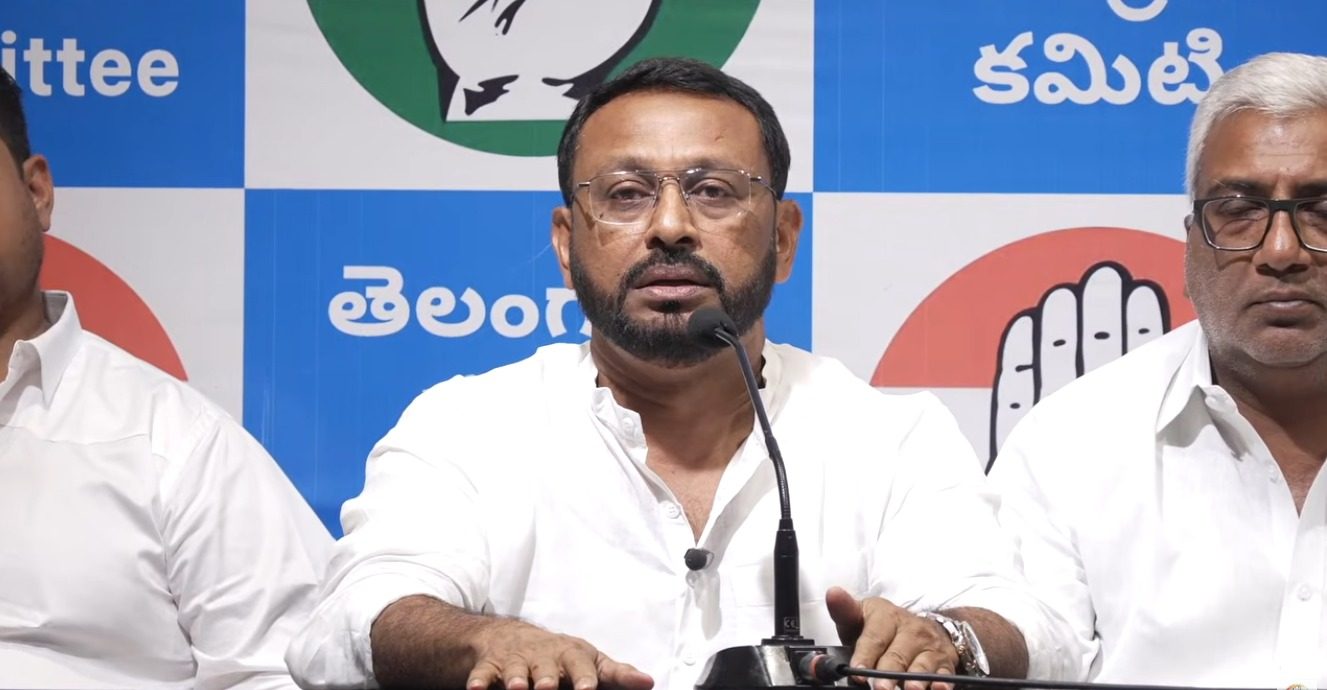
the Congress had placed before the Chief Electoral Officer on October 1 Form 7 applications from Musheerabad in which the names, addresses and electoral details of a Congress booth-level agent and more than 30 members of his family had allegedly been printed in advance.
According to him, only the objector’s name was entered by hand, and the person shown as the objector was a BJP booth-level agent. “This was not a voter sitting at home and filling a Form 7 from personal knowledge. Someone first extracted the electoral data, sorted an entire family, printed the forms and then left only one blank for the objector’s name,” Nizamuddin said.
He said this distinction was crucial because Form 7 was meant to be an individual objection based on a specific ground, not a mass-produced political instrument.
Nizamuddin alleged that similar pre-printed stocks had also been prepared for Bahadurpura and Goshamahal and claimed that after the Musheerabad case became public, thousands of forms prepared for constituencies in Hyderabad were held back from submission. He further claimed that around 70,000 Form 7 applications were reportedly lying with a BJP constituency in-charge in one Hyderabad Assembly segment. “If the Election Commission has accepted only about 30,000 Form 7 applications in the entire State, but tens of thousands more have allegedly been printed and kept ready in just one constituency, the Commission cannot treat this as a routine objection process,” he said.
Nizamuddin said the forms that had not yet been submitted were now more important than those already filed because they could reveal who prepared them, how voter data was sourced and whether the exercise was centrally organised. He said the Congress wanted every pre-printed, bulk-copied or single-person batch of Form 7s to be immediately impounded, photographed and sealed before the evidence disappeared. He also demanded that fresh bulk Form 7 applications should not be accepted until the authorities established and recorded their chain of custody.
Referring to the Chief Electoral Officer’s clarification that a Form 7 does not automatically result in deletion, Nizamuddin said the Congress was not questioning the existence of the scrutiny process but was raising a more fundamental issue. “The CEO has explained what happens to a voter after a Form 7 is filed. We are asking what happened before the Form 7 reached the booth. Who downloaded the roll? Who selected the family? Who printed the forms? Who distributed them? And on whose instructions?” he asked.
He said even if a false objection was eventually rejected, the alleged organised use of electoral-roll data to prepare deletion applications in advance remained a serious matter.
Nizamuddin demanded complete download logs for Musheerabad, Bahadurpura and Goshamahal, including details of the login used, the date of export, the terminal from which the data was accessed and the platform through which it was obtained. He said the Election Commission should clarify whether the relevant voter information was exported from the CEO’s system, an Electoral Registration Officer login, the BLO application or any portal accessible to political party booth-level agents.
The TPCC leader also sought a field-by-field comparison between the disputed printed Form 7 applications and the official electoral-roll export. “Without the download log, we are left with an allegation. The moment the log is produced, the trail becomes verifiable,” he said.
Nizamuddin also demanded a full paper trail to establish which press printed the forms, who paid for them, who transported them and who handed them over at the booth level. He said the identity of the handwritten objector should also be physically verified in every suspicious case.
Pointing out that even an elector filing more than five objections was required to undergo mandatory review by the Electoral Registration Officer, he said an objection against more than 30 members of one family should have triggered immediate scrutiny. He further demanded that every objection be matched with the ground cited in the form. “If the ground is death, there must be a corresponding record with the Registrar of Births and Deaths or a proper BLO field report. A person cannot simply mark a living voter as dead because somebody handed him a printed list,” he said.
Nizamuddin demanded that until the inquiry was completed, no name should be deleted on the basis of a pre-printed or bulk Form 7 unless the objector appeared personally, the affected elector was given a hearing and a reasoned speaking order was passed. He also questioned reliance on SMS alerts, saying a message to a linked mobile number could not be treated as adequate service of notice, particularly when around 7.41 lakh notices in the ongoing revision had already remained unserved. “Non-service cannot become a shortcut to deletion,” he said.
Nizamuddin said the urgency was greater because the claims and objections window would close on October 7, while the final electoral roll was scheduled for publication on November 9. “If the evidence is seized after the final roll is published, the damage will already have been done. The Election Commission must act before the process closes, not after it,” he said.
He said the BJP must also explain how booth-level agents allegedly came into possession of family-wise, pre-filled Form 7 applications. “This is not about one booth or one family anymore. It is about whether voter deletion is being converted into an organised political exercise using electoral-roll data,” he said.
Summing up the Congress demand, Nizamuddin said: “Publish the download logs, seize the forms that have not yet been submitted, identify who printed and distributed them, and stop any deletion from a Form 7 whose voter fields were filled before the objector signed.”